Validation 101: Ensuring Compliance and Quality with Computer System Validation
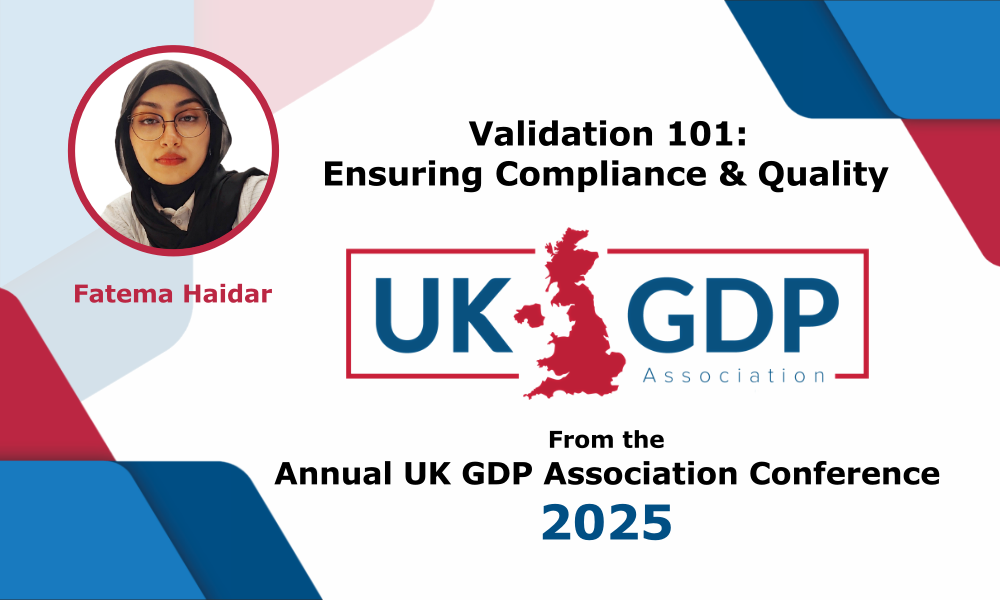
At the 2025 UK GDP Association Annual Conference, one session stood out for its practical relevance and regulatory depth: “Validation 101,” presented by Fatema Haidar of OneSC.
In a landscape where digital systems underpin nearly every quality, compliance, and operational process in pharmaceutical companies, Fatema’s talk served as an essential primer on why computer system validation (CSV) is not just good practice, it is regulatory expectation!
Her insights clarified not just the what and why, but also the how of achieving robust, compliant systems that meet the expectations of regulators such as the Medicines and Healthcare products Regulatory Agency (MHRA), Food and Drugs Administration (FDA), and European Medicines Agency (EMA).
About the Speaker: Fatema Haidar
Fatema Haidar is a User Experience (UX) Designer and Business Analyst at OneSC, bringing a unique blend of technical insight, process understanding, and user-centric perspective to complex digital environments.
With several years’ experience delivering digital solutions and supporting go-to-market pharmaceutical technologies, Fatema is adept at translating detailed regulatory and technical requirements into tools that are both compliant and practical for quality and supply chain teams.
Her session at the UK GDP Association conference drew from both her analytical experience and her exposure to CSV as part of digital solution development, bridging the worlds of regulatory expectation and real-world system use.
Overview: What is OneSC?
OneSC (One Supply Chain Ltd) is a UK-based SaaS (Software as a Service) platform designed to support life sciences and pharmaceutical organisations in streamlining supply chain, quality, and regulatory operations.
It brings together tools for documentation, collaboration, and batch lifecycle tracking in a single, cloud-based environment powered by AI, machine learning, and connected data workflows.
OneSC’s platform is tailored to overcome the common challenges of fragmented systems, siloed communications, and manual artefact handling that slow down critical quality release and compliance tasks.
The platform’s aim is to provide end-to-end visibility, simplify quality review processes, ensure regulatory compliance, and reduce operational risk, ultimately enabling faster and more confident product release activities. Central to its value proposition is a validated system environment that aligns with industry best practices for regulated use.
Why Computer System Validation Matters
In regulated environments such as Good Distribution Practice (GDP) and Good Manufacturing Practice (GMP), computerised systems form a critical part of the Quality Management System (QMS).
These may include systems for document control, batch release, CAPA (Corrective and Preventive Actions), change control, electronic signatures, data storage, and audit trails. Regulators including the UK’s Medicines and Healthcare products Regulatory Agency (MHRA) expect that any system used to manage GxP data or processes is validated to ensure it consistently produces reliable and accurate results. Without this, organisations expose themselves to risk, regulatory scrutiny, and potential non-compliance findings.
At the conference, Fatema emphasised that CSV isn’t optional, it’s a baseline expectation.
A validated system demonstrates to auditors and inspectors that an organisation knows its systems are functioning correctly and that data integrity, security, and process compliance are maintained.
Core Components of Validation
Fatema walked delegates through the major elements that make up a comprehensive CSV programme, highlighting key considerations for each:
-
- Validation Planning – A structured approach outlining scope, responsibilities, and deliverables.
- Audit & Data Integrity – Ensuring audit trails and data remain intact, traceable, and unaltered throughout the system life cycle.
- Security & Electronic Signatures – Protecting access and ensuring only authorised, authenticated users can interact with regulated functions.
- Change Control – Controlled processes for approving system changes to preserve validated state.
- Back-up, Recovery & Disaster Recovery – Demonstrating continuity plans for data and operations.
- Supplier Management – Evaluating third-party vendors and cloud providers to ensure they meet compliance standards.
- Training & Documentation – Providing evidence that personnel understand how to use and support validated systems.
- Incident/Error Handling – Recording and resolving system issues that could impact quality or compliance. (Session summary)
Fatema’s practical framing helped demystify what can be a daunting topic for organisations early in their CSV journey.
GAMP: The Best Practice Framework
Central to Fatema’s session was GAMP (Good Automated Manufacturing Practice), a well-recognised industry framework that underpins computer system validation globally.
GAMP provides structured guidance on categorising systems, assessing risk, and aligning validation effort with risk impact. When applied effectively, GAMP supports patient safety, product quality, and data integrity, the three pillars of CSV in regulated environments.
In Fatema’s explanation, embracing GAMP builds confidence in your systems so that when regulators audit your processes, you can clearly demonstrate control, rationale, and compliance.
GDP vs GMP: Different Approaches, Same Principles
Fatema also drew a helpful distinction between GDP and GMP environments:
-
- GMP often involves more detailed process risk because it governs product manufacturing and supply from scratch, where risks of contamination, mixing, or process deviations are higher.
- GDP, meanwhile, generally focuses on distribution and handling after manufacture, including maintaining product quality through logistics, storage, and release activities.
Both frameworks require validated systems, but GMP’s greater inherent risk means deeper validation emphasis, whereas in GDP, a risk-based approach helps calibrate validation effort proportionate to system impact.
Re-Validation and Ongoing Compliance
One of the most practical takeaways from the session was the emphasis on re-validation.
Validation isn’t a single activity performed at installation. Organisations must demonstrate that systems continue to work as intended post-implementation. Lack of revalidation is often a finding during MHRA inspections, don’t get caught out, ensure you have a revalidation programme in place.
Revalidation involves:
-
- Documenting post-implementation effectiveness checks.
- Recording acceptance criteria, test results, and evidence gathered during validation activities.
- Capturing outcomes and confirming system performance or generating CAPAs if needed. (Session summary)
This ensures that systems remain compliant throughout their operational life cycle, particularly as updates, integrations, and organisational needs evolve.
Final Thoughts: Practical Integrity for Real-World Quality
Fatema’s “Validation 101” session reminded conference delegates of a simple but powerful truth: validated systems are the foundation of reliable, compliant quality operations.
In an age where digital tools are central to everything from CAPA management to supply chain traceability, organisations cannot afford to treat validation as an afterthought. By connecting regulatory expectations, practical steps, and real-world implementation challenges, Fatema delivered a session that was both accessible and immediately relevant.
Whether your organisation is just starting its validation journey or looking to optimise existing practices, the principles shared during this session serve as a strong baseline for moving forward.
Do you need some support with validating your computer system?
If you are struggling with validating your computerised system or not sure where to start, our conference gold sponsors can help. Visit Paradigm Shift Consulting to find out more.
Registering for the 2026 conference
There are discounted tickets available for UK GDP Association members, members can save £100 when attending both conference days. However, our commitment to low-cost, high-value educational content means that conference tickets will still be the best value whether you chose to join as members or not.
Membership is only £29 +VAT per individual, per year and offers reduced costs on consulting, training and conference tickets. If you buy tickets for both conference days, there is an even greater discount. Costs for non-members is just £224.50 per day, a fraction of the cost of other industry events!
In addition, on the evening of Tuesday 16th June, we will be hosting an evening event of dinner, networking, and even some of Dave’s infamous karaoke, for just £49 +VAT per person. This is a fundraising dinner in aid of the MVA Society.
Please see here for more information on the conference and to book your conference and evening dinner tickets.
We are very much looking forward to seeing you all at the conference!
 2025 Conferences