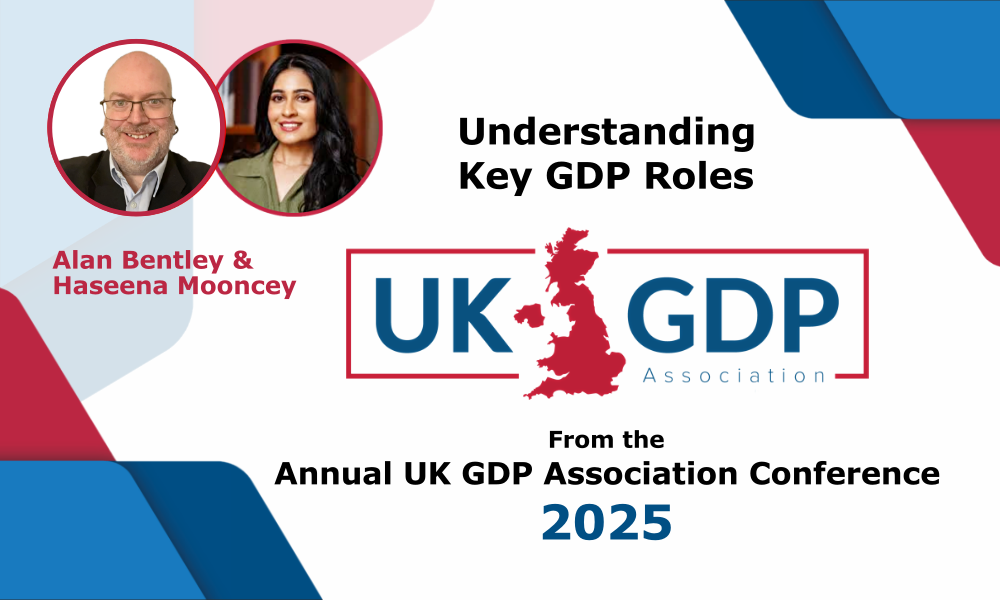
Understanding Key GDP Roles
with Alan Bentley and Haseena Mooncey
The 2025 UK GDP Association Annual Conference brought together a wide range of speakers, but one session that truly resonated with delegates was the joint presentation on Key GDP Roles delivered by two well-known industry experts, Alan Bentley and Haseena Mooncey. Their combined experience in pharmaceutical quality, compliance, Responsible Person oversight and quality recruitment created an engaging and highly practical session, one that offered clarity on some of the most misunderstood aspects of GDP governance.
Meet the Speakers
Alan Bentley – Kitsune Kaizen
Alan, a former Senior Lead GDP Inspector at the MHRA, is the co-founder and director of Kitsune Kaizen, a specialist consultancy known for its expertise in GDP, GMP, operational organisation, auditing and supporting organisations through regulatory challenges. He has spent decades working across supply chain operations, quality leadership, and continuous improvement. His approach blends technical expertise with a people-first philosophy, helping companies embed quality into everyday practice.
Haseena Mooncey – CHR Life Sciences
Haseena is an established GDP specialist with a strong background in recruitment of specialist pharmaceutical professionals. At CHR Life Sciences, she supports organisations seeking experienced GDP personnel, including Responsible Persons, QA Professionals, and supply chain experts. Her insights into the recruitment landscape, regulatory expectations, and the realities of sourcing competent RP candidates added an invaluable dimension to the session.
Together, Alan and Haseena created a rare dual-perspective presentation: one from the quality and compliance lens, and one from the recruitment and people-management side.
Key GDP Roles Explained
The session began by clarifying the main GDP-related roles across the supply chain, including:
· Responsible Person (RP)
· Responsible Person (Import) (RPi)
· Qualified Person (QP)
· Quality Controller (QC)
· Wholesale Qualified Person (WQP)
· Designated Person (DP)
This overview was particularly helpful for organisations who hold multiple licences, WDA(H), WDA(V), MIA, or active substance registrations, as responsibilities can overlap or be misunderstood.
The Responsible Person (RP)
The speakers focused on the RP, the most central GDP role under UK legislation.
Key points included:
· Under Regulation 45 of the Human Medicines Regulations 2012, the Licence Holder (LH) must appoint an RP
· The RP acts as a compliance safeguard, ensuring the LH meets GDP obligations
· 12 core responsibilities are outlined in the EU GDP Guidelines Chapter 2 and the MHRA Green Guide
· The RP must have 12+ months of QMS and wholesale experience
· The RP must personally fulfil the role, not delegate it entirely
· Competence must be demonstratable via training, experience and ongoing Continuous Professional Development (CDP)
A particularly important emphasis was placed on the relationship between the RP and LH.
Note: The Licence Holder and RP should NOT be the same person unless the organisation is very small.
This supports the separation of duties, impartiality, and transparency during regulatory inspections. They also highlighted MHRA Guidance Note 6 which provides key guidance for WDA application requirements, including expectations relating to RP experience, oversight, and documentation.
Multiple RPs – A Smart Risk Mitigation Strategy
Many organisations assume having more than one RP complicates matters, but Alan explained the opposite:
“If you have multiple RPs, define individual responsibilities in writing.”
This means that if one RP is deemed incompetent in a specific area, the MHRA may remove only that RP, rather than all RPs on the licence. This can protect the business from unnecessary operational disruption.
A well-structured:
· Job description
· Delegation matrix
· Responsibility log
… is essential to demonstrate oversight and role clarity.
Delegation vs Responsibility
One of the most misunderstood areas of GDP is the idea of delegation. The presenters clarified:
· Tasks can be delegated
· Responsibility cannot
· The RP must still review and sign off delegated work
· The DP typically acts as a deputy but not a replacement RP
This distinction is vital for regulatory inspections, where the RP’s accountability is often tested.
RP Competency & Continuous Professional Development
Competence is not a one-time achievement; it is an ongoing requirement. The session stressed:
· Gold Standard RP training is highly beneficial
· Knowledge gaps must be identified and addressed properly
· GDP training must be ongoing and recorded
· CDP logs must be maintained
· Inspectors often evaluate the RPs competency directly
Importantly when inspectors realise deficiencies related to an RP the MHRA expects the LH to mentor and retrain the existing RP, rather than simply replace them. This shows a healthy GDP culture and commitment to improvement.
Employee vs Contractor: Recruitment Realities
Haseena provided invaluable insight into the recruitment of RP’s, particularly in situations where:
· An RP resigns
· An RP is removed following critical findings
· The business model changes
· A new licence variation requires additional expertise
Her advice included:
1. Be honest with recruiters
Regulatory history, critical findings, and current compliance status should be shared. Recruiters understand these situations well and can better prepare candidates.
2. Explain the business model clearly
For example, if the licence involves:
· Controlled drugs
· Cold chain
· Import/export
· Specials
· High-volume supply
· Veterinary products
…then recruiters can filter candidates with matching experience.
3. Consider interim or consultancy support
Consultant RP’s can:
· Provide short-term cover
· Mentor new RP’s
· Strengthen compliance
· Support during MHRA variations and inspections
If using a contract RP, organisations must ensure:
· A Quality Technical Agreement (QTA) is in place
· Time-on-site expectations are defined
· Responsibilities and boundaries are clear
A Thought-Provoking and Practical Session
Delegates praised Alan and Haseena for delivering a balanced, honest, and deeply practical session. Their combined expertise helped clarify complex GDP roles and shed light on the importance of competency, documentation, separation of duties, and the human element behind regulatory compliance. As many attendees commented, the session was a valuable reminder that GDP success starts with the right people, in the right roles, with the right support.
Registering for the UK GDP Association Conference 2026
There are discounted tickets available for UK GDP Association members, members can save £100 when attending both conference days. However, our commitment to low-cost, high-value educational content means that conference tickets will still be the best value whether you chose to join as members or not.
Membership is only £29 +VAT per individual, per year and offers reduced costs on consulting, training and conference tickets. If you buy tickets for both conference days, there is an even greater discount. Costs for non-members is just £224.50 per day, a fraction of the cost of other industry events!
In addition, on the evening of Tuesday 16th June, we will be hosting an evening event of dinner, networking, and even some of Dave’s infamous karaoke, for just £49 +VAT per person. This is a fundraising dinner in aid of the MVA Society.
Please see here for more information on the conference and to book your in-person or virtual conference and evening dinner tickets.
We are very much looking forward to seeing you all at the conference!
 2025 Conferences